TL;DR: Fast Facts for Your Fukui Itinerary
-
The Route: The Hokuriku Shinkansen officially extended to Tsuruga (Fukui Prefecture) on March 16, 2024.
-
Travel Time: You can now travel directly from Tokyo to Fukui Station in just under 3 hours via the Kagayaki train.
-
The Cost: A standard reserved seat from Tokyo to Fukui costs approximately ¥16,030.
-
The Draw: Fukui is the antidote to over-tourism, offering deep-rooted Zen history, rugged coastal landscapes, and premium seafood like Echizen crab, far from the shoulder-to-shoulder crowds of Kyoto and Tokyo.
If you are exhausted by the thought of elbowing your way through Kyoto’s Arashiyama bamboo grove or standing in hour-long queues for a single bowl of ramen in Tokyo, it is time to look toward the Sea of Japan coast.
For decades, Fukui Prefecture was a quiet, slightly hard-to-reach enclave known mostly to domestic travelers. But with the recent extension of the Hokuriku Shinkansen terminating in Tsuruga, the map of Japanese travel has fundamentally shifted. Now, in 2026, travelers can trade the metropolitan gridlock for the quiet mist of Eiheiji Temple in under three hours from Tokyo. As a fully licensed inbound travel agency headquartered right next door in Kanazawa, our team at HokuList Japan spends our weeks inspecting these routes and locations. We know the exact carriage to board, the specific humidity of a Hokuriku summer, and why Fukui deserves a prominent spot on your itinerary.
Here is your definitive, on-the-ground guide to navigating and experiencing Fukui.
The Hokuriku Shinkansen: 2026 Routes, Times, and Fares
The extension of the Shinkansen line past Kanazawa, weaving through Awara Onsen, Fukui City, Echizen-Takefu, and terminating at Tsuruga, has reshaped Central Japan’s transit network. For Tokyo departures, look for the Kagayaki (the express service) or the Hakutaka (which makes more regional stops).
Direct Answer: How long does it take to get to Fukui?
Riding the Kagayaki from Tokyo Station to Fukui Station takes approximately 2 hours and 51 minutes. To reach the end of the line at Tsuruga, expect a journey of about 3 hours and 8 minutes.
Approximate One-Way Fares (2026)
| Route | Standard Class (Reserved) | Green Car |
| Tokyo – Fukui | ¥16,030 | ¥23,880 |
| Tokyo – Tsuruga | ¥16,580 | ¥24,430 |
| Kanazawa – Fukui | ¥3,450 | ¥4,720 |
Note: For travelers holding the JR Pass or Hokuriku Arch Pass, these routes are fully covered, making Fukui an incredibly cost-effective detour.
Discovering Fukui: Where to Go and What to Taste
Forget generic tourist traps; Fukui is an immersion into texture, flavor, and history. Here is what we prioritize when building itineraries for our clients.
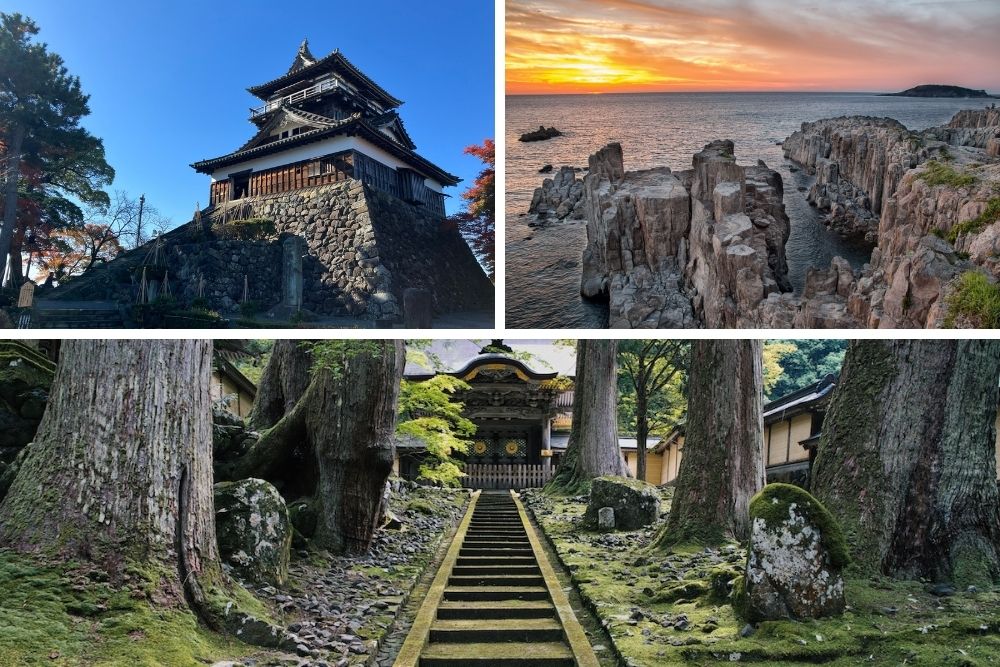
Eiheiji Temple: The Weight of Silence
Nestled deep in a cedar forest outside Fukui City, Eiheiji is not a museum; it is an active monastery and one of the two head temples of the Soto Zen sect. When you walk the covered wooden corridors connecting the 70 buildings, you are met with the scent of damp earth and centuries-old cedar timber. Listen closely, and the silence is only broken by the rushing river outside, the slap of monks’ bare feet on the polished floorboards, or the sharp crack of the kyosaku (wooden stick) during meditation.
-
Local Tip: Take the direct express bus from Fukui Station’s East Exit. It takes 30 minutes and drops you right at the temple gates, sparing you a confusing local train transfer.
Fukui Prefectural Dinosaur Museum: A Prehistoric Deep Dive
Fukui is the undisputed dinosaur capital of Japan, where the majority of the country’s fossils have been excavated. Located in the mountainous Katsuyama area, stepping off the massive 33-meter escalator into the cavernous silver dome of this museum feels like descending into another era. The space houses 44 full dinosaur skeletons, set against the low, mechanical hum of remarkably lifelike animatronics.
-
Local Tip: Tickets are strictly by advance reservation only. Do not show up at the door expecting to buy entry. Book online well before your travel dates, especially on weekends.
Echizen Daibutsu (Seidaiji Temple): Colossal Serenity
Just a short drive from the Dinosaur Museum sits one of Japan’s most visually striking, yet uncrowded, spiritual sites. The Echizen Daibutsu towers 17 meters tall—making it larger than the famous Great Buddha in Nara. Because it was built relatively recently (in 1987) by a local businessman, it lacks the historical fame of older temples, resulting in vast, empty courtyards. The sheer quiet of the complex amplifies the visual weight of the massive copper Buddha, flanked by thousands of smaller, meticulously carved stone disciples lining the walls of the great hall.
-
Local Tip: Climb to the top floor of the complex’s five-story pagoda for a sweeping, unobstructed view of the Katsuyama basin and the surrounding Hakusan mountain range.
Tojinbo Cliffs: The Rugged Edge of Japan
Formed by volcanic activity over 12 million years ago, this one-kilometer stretch of hexagonal basalt pillars plunges directly into the Sea of Japan. The wind here is heavy with salt, and the slate-grey waves crash violently against the rock face.
-
Local Tip: Skip the summer visit if you want the true atmosphere. The dramatic, moody skies of late autumn and winter offer the best backdrop for photography. Warm up afterward with grilled squid from the seaside vendors lining the walking path.
Maruoka Castle: Surviving the Centuries
Unlike the concrete reconstructions found in many major cities, Maruoka Castle in Sakai City is one of Japan’s twelve original surviving keeps. Climbing to the top requires ascending wooden stairs so steep and creaky that ropes are provided to pull yourself up. The tactile experience of running your hand over the unvarnished, battle-worn timber offers a visceral connection to the 16th century.
Echizen Gastronomy: Beyond Sushi
Fukui’s culinary identity is fierce and distinct.
-
Echizen Gani (Snow Crab): Available only from November to March, this crab is so highly regarded it is traditionally presented to the Imperial Family. You will recognize the genuine article by the yellow plastic tag fastened to its claw. The meat is intensely sweet, with a firm, delicate fiber. Head to the port town of Mikuni to eat it fresh off the boats.
-
Echizen Oroshi Soba: A stark contrast to warm noodle dishes, this local staple features firm, dark buckwheat noodles served cold in a savory broth, heavily topped with the sharp, peppery bite of raw grated daikon radish and bonito flakes.
Navigating Fukui Like a Local: Our On-the-Ground Advice
While the Shinkansen brings you to the prefecture’s doorstep, mastering the local terrain requires a bit of insider knowledge.
-
Embrace the Rental Car: To truly explore the Echizen coast or the mountainous Katsuyama area (home to the exceptional Fukui Prefectural Dinosaur Museum), public transport can be frustratingly sparse. Renting a car at Fukui or Tsuruga stations gives you the freedom to explore at your own pace.
-
Respect the Hokuriku Weather: We have a saying in this region: “Even if you forget your lunch box, don’t forget your umbrella.” The weather off the Sea of Japan is notoriously fickle. Always pack a lightweight rain jacket, regardless of the forecast.
-
The Echizen Railway Charm: If you opt against driving, ride the local Echizen Railway. The single-car, scenic trains move slowly through rice paddies and small villages. It requires patience, but it provides a nostalgic, unhurried view of rural Japanese life.
The 2026 travel season represents a golden window for Fukui. The infrastructure is brand new, yet the crowds have not yet fully materialized. By looking past the traditional Tokyo-Kyoto-Osaka route, you open yourself up to a side of Japan that remains rugged, spiritual, and beautifully intact.

Comment